
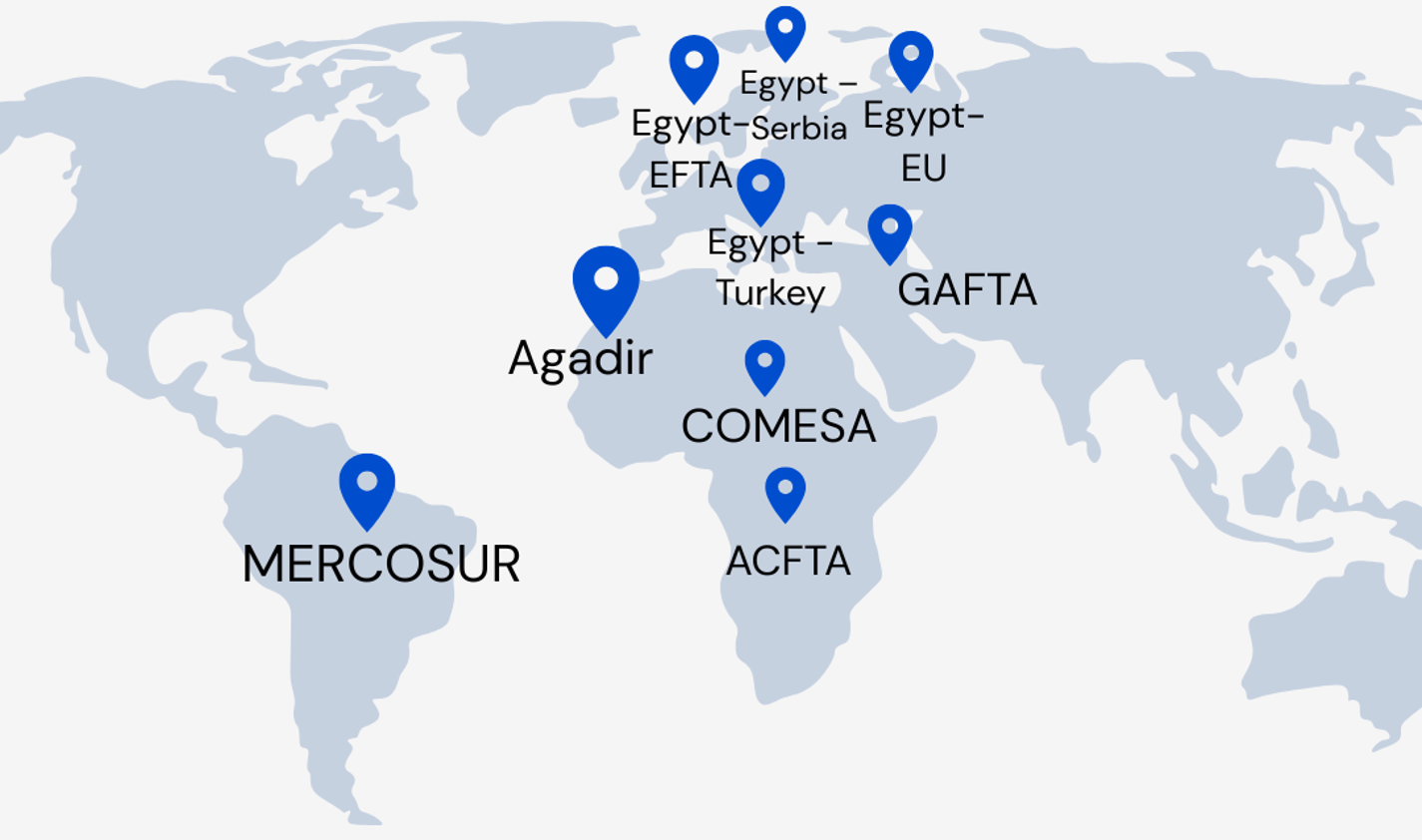
Egypt Trade Agreements in 4 Locations
COMESA Agreement
Common Market for Eastern and Southern Africa (COMESA) has 21 member states: Egypt, Kenya, Sudan, Libya, Zambia, Malawi, Zimbabwe, Ethiopia, Djibouti, Madagascar, Uganda, Eritrea, the Democratic Republic of the Congo, Burundi, Rwanda, Seychelles, Comoros, Eswatini, Mauritius, Tunisia, and Somalia.
Tariff Concessions and Reductions Offered by the Agreement
- There are 15 countries applying full duty exemption (under the COMESA Free Trade Area); Egypt, Kenya, Sudan, Mauritius, Madagascar, Zimbabwe, Malawi, Djibouti, Zambia, Rwanda, Burundi, Comoros, Libya, Seychelles, and Tunisia.
- Eritrea applies an 80% customs duty reduction.
- Uganda has announced that it applies a full customs duty exemption, but there is a list of products that do not apply the tariff exemption.
- Ethiopia applies 10% customs duty reduction.
- Democratic Republic of Congo, Eswatini and Somalia do not apply any customs duty exemptions.
The COMESA agreement stipulates that the traded goods must comply with the COMESA rules of origin and be accompanied by a COMESA certificate of origin.
African Continental Free Trade Area
- The African Continental Free Trade Area (AfCFTA) is the world’s largest free trade zone, uniting 54 of 55 African Union nations to create a single market for goods and services, aiming to boost intra-African trade, industrialization, and economic growth by reducing tariffs and eliminating non-tariff barriers, and diversifying economies from commodity reliance.
- The agreement was signed in 2018 and entered into force on January 1, 2021, it covers trade in goods, services, investment, and intellectual property, with its secretariat based in Accra, Ghana, fostering African unity and economic integration.

The Greater Arab Free Trade Area (GAFTA)
- The Greater Arab Free Trade Area (GAFTA) includes Jordan, United Arab of Emirates, Bahrain, Tunisia, Saudi Arabia, Syria, Egypt, Iraq, Sultanate of Oman, Qatar, Kuwait, Lebanon, Libya, Morocco, Sudan, Yemen and Algeria.
- There is a tariff exemption among the member states provided that the traded goods must comply with the GAFTA rules of origin and be accompanied by a GAFTA certificate of origin.
The Greater Arab Free Trade Area (GAFTA)
- The Greater Arab Free Trade Area (GAFTA) includes Jordan, United Arab of Emirates, Bahrain, Tunisia, Saudi Arabia, Syria, Egypt, Iraq, Sultanate of Oman, Qatar, Kuwait, Lebanon, Libya, Morocco, Sudan, Yemen and Algeria.
- There is a tariff exemption among the member states provided that the traded goods must comply with the GAFTA rules of origin and be accompanied by a GAFTA certificate of origin.
Mercosur
- Egypt signed the Free Trade Agreement with Mercosur countries (Brazil, Argentina, Uruguay and Paraguay) and entered into force in 2017.
- There are tariff exemptions on the first three lists and the fourth one will be fully tariff exempted by 2026.

Egypt – EU Association agreement
Egypt signed the free trade agreement with the EU in 2001 and entered into force in 2004. There is tariff exemption on the traded goods provided they apply the agreed rules of origin and accompanied by the certificate of origin of the agreement.
Egypt Association agreement
The UK – Egypt association agreement was entered into force in 2021. There is tariff exemption on the industrial products.
Egypt – Turkiye Free Trade Agreement
Egypt signed free trade agreement with Turkiye in 2005 and entered into force in 2007. There is tariff exemption on the traded goods provided they apply the agreed rules of origin and accompanied by the certificate of origin of the agreement.
Egypt – EFTA Free Trade Agreement
Egypt has ratified and implemented a Free Trade Agreement with the European Free Trade Association (EFTA) including Iceland, Liechtenstein, Norway, and Switzerland. The agreement was signed and entered into force in 2007, aiming to liberalize trade, eliminate tariffs on industrial and agricultural goods, and promote economic integration, with customs duties on industrial products largely eliminated by 2020.
Egypt – Serbia Free Trade Agreement
Egypt signed free trade agreement with Serbia in July 2024 and entered into force on September 1, 2025. Some of the Egyptian products will be exempted from the customs duties after 4 years and others after 10 years.